
Mission “Baikalpik Soch” – A National Dialogue on Nepal’s Future
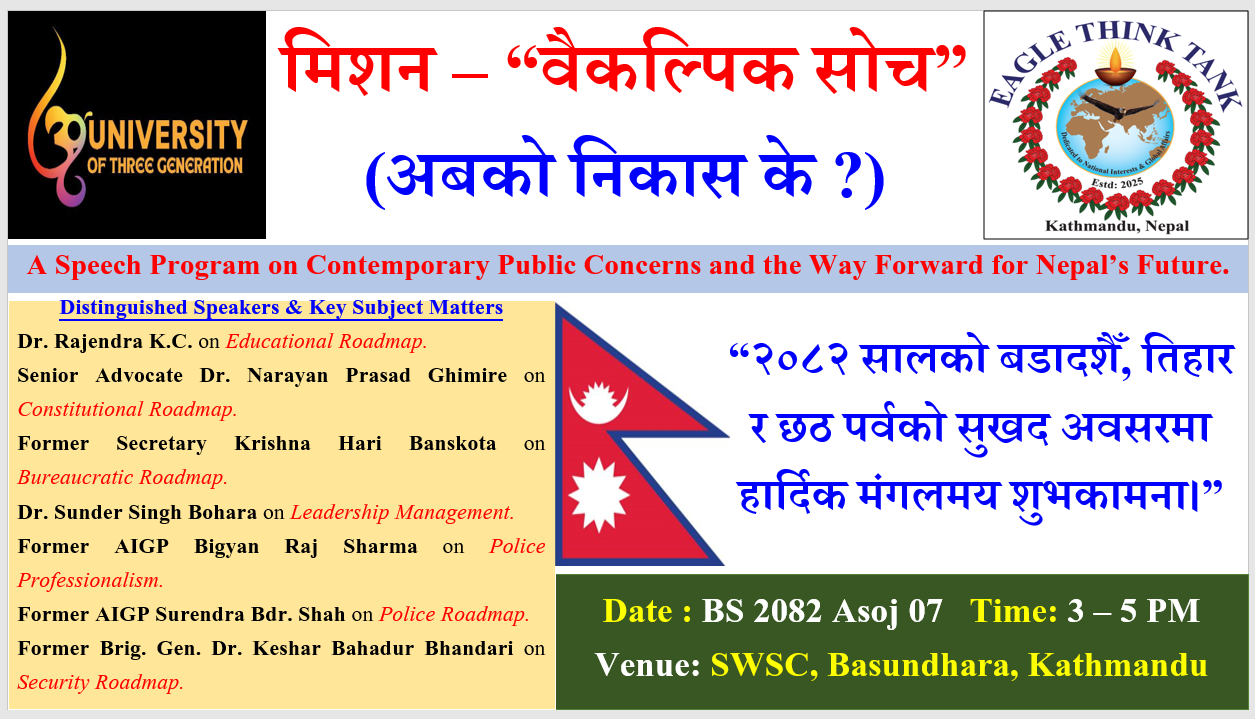
In an atmosphere filled with dialogue, reflection, and collaboration, the University of Three Generations and the Eagle Think Tank jointly organized a high-level strategic forum titled Mission “Baikalpik Soch” (Alternative Thinking): What is the Way Forward? at the Southwestern State College Hall, Basundhara, Kathmandu on 23 September 2025 (Asoj 7, 2082)
The event was funded entirely by the private income of the organizers, reflecting their commitment to independence and neutrality. The main aim was to openly discuss Nepal’s pressing challenges and to design practical, long-term strategies that can serve the nation’s future generations.
The program opened with a solemn tribute to those who lost their lives during the recent Gen Z Movement, accompanied by heartfelt wishes for the speedy recovery of those injured. The organizers also extended warm greetings for the approaching festivals of Dashain, Tihar, and Chhath, symbolizing a spirit of hope, harmony, and resilience among Nepali people.
Speaking on behalf of the University of Three Generations, Dr. Rajendra K.C., Chairman, recalled the vision that guided its establishment in 2078 BS. He said:
“Our mission is to bring together children, youth, and adults so that the wisdom of all generations can be connected. By uniting knowledge, skills, and capacity, we aim to use Nepal’s art, culture, and geography more effectively. The goal is to promote good governance and ensure the participation of every citizen in national life.”
Representing the Eagle Think Tank, Founder and Managing Director, Former Brigadier General Ram Chandra Khatry, Sukeerti Padak, (Nepali Army), joined by Founder and Director Former Honorary Major General Ratna Bahadur Godar, (Nepali Army) and Founder and Director Former Colonel Direndra Malla, (Nepali Army) underlined the institution’s core mission:
“Our think tank, which was set up earlier this year, stands on five strong pillars—Security, Diplomacy, Environment, Leadership, and Human Resource Management. We are determined to safeguard Nepal’s national interests, strengthen its institutions, and contribute to informed discussions on international issues.”
Speakers spoke openly about Nepal’s current situation. They noted that political instability, weak governance, unemployment, and lack of accountability have created public dissatisfaction and uncertainty. The Gen Z Movement, though painful, was seen as an important reminder that young people and citizens are demanding real reforms, justice, and effective governance. The call for “alternative thinking” was described as not optional but necessary for Nepal’s stability and future progress.
The program featured seven distinguished keynote speakers, each contributing their perspective and concrete ideas for the way forward:
- Rajendra K.C. – Proposed an Educational Roadmap that emphasizes innovation, inter-generational learning, and practical reforms suited for Nepal’s context.
- Senior Advocate Dr. Narayan Prasad Ghimire – Called for constitutional reforms and clarity, stressing the role of the Interim Government in addressing people’s genuine demands and restoring institutional trust.
- Former Secretary Krishna Hari Banskota – Suggested a Bureaucratic Roadmap that promotes results, ensures transparency, and strengthens accountability in public administration.
- Sundar Singh Bohara – Spoke on Leadership Management, encouraging the nurturing of leaders who are ethical, visionary, and capable of uniting people in times of crisis.
- Former AIGP Bigyan Raj Sharma, Nepal Police – Focused on Police Professionalism, highlighting neutrality, discipline, and dedication to public service, especially during sensitive movements.
- Former AIGP Surendra Bahadur Shah, Nepal Police – Outlined a Police Roadmap based on modernization, trust-building, and people-centered policing.
- Former Brig. Gen. Dr. Keshar Bahadur Bhandari, Nepali Army – Presented a Security Roadmap with a long-term vision of aligning civil-military relations, strengthening security policy, and ensuring stability during crises.
Several intellectuals and participants put their opinions and concerns about the professionalism and restraint shown by Nepal’s security forces during the recent Gen Z movement. Despite the difficult circumstances, the security agencies were acknowledged for acting responsibly, maintaining discipline, and protecting lives and property while respecting the rights of citizens. This professionalism was described as a foundation for building trust between the state and the people.
During the interactive session, participants from academia, civil society, the diplomatic community, bureaucracy, and media offered constructive comments. Many urged for neutrality, responsibility, and accountability as guiding principles for Nepal’s future. The dialogue emphasized that diverse voices must be heard, and solutions must be designed collectively, not imposed.
The program concluded with a group photograph and expressions of gratitude to the more than 100 distinguished participants, who represented different sectors of society. Organizers assured that the roadmaps prepared during the forum will be shared with relevant authorities and the wider public through appropriate and transparent channels.
Both institutions the University of Three Generations and the Eagle Think Tank reaffirmed their shared conviction: Nepal’s way forward lies in alternative thinking, professional responsibility, and inclusive national dialogue. By combining the energy of the young, the experience of the older generation, and the commitment of security and governance institutions, Nepal can move toward a more stable, just, and prosperous future.